DOES GENDER-AFFIRMING CARE
REDUCE SUICIDE RISK?
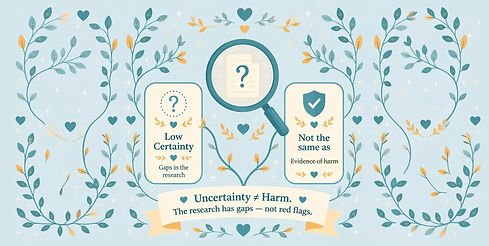
Research consistently links gender-affirming care and accepting environments to lower suicide risk among transgender young people. Multiple studies associate supportive care with lower rates of depression and suicidal thoughts, and family acceptance with lower rates of suicide attempts. It is important to read these findings carefully: they show association rather than proof of cause, and the elevated risk they describe is driven by stigma and mistreatment, not by being transgender. Major US medical organizations regard this care as evidence-based and medically necessary, while some evidence reviews note that the certainty of the long-term research is still limited. Low certainty in a body of research is a statement about study quality, not a finding that care is harmful.
Before the numbers, the most important thing to hold onto is that support helps. Across this research, the factors linked to lower risk are the ones within reach of families and communities: acceptance, respect, and access to care. If your family is navigating this, that is genuinely good news, and the resources gathered on our where to get help page are there whenever you need them.
Terminology and language note: You may see this care called gender-affirming care, transition-related care, or supportive care; this page mostly uses "supportive care," and the terms describe the same thing. This page also keeps precise language throughout: "suicidal thoughts" or "suicidal ideation" for thoughts, "suicide attempts" for attempts, and "suicide" only for deaths. These are different outcomes, and most of the research here measures thoughts, not deaths.
CONTENT NOTE
This is information, not medical advice, and it explains a clinical scale rather than any individual's care. Whether and when any medication is appropriate for a particular young person is a decision for that young person, their family, and their qualified healthcare providers, and in nearly all cases minors cannot receive it without parental consent. If you are in immediate danger, call 911; for support any time, call or text 988.
-
The research points one way. Studies consistently link supportive care and acceptance to lower rates of depression, suicidal thoughts, and suicide attempts among trans youth.
-
These are associations. The studies show that support and better outcomes move together, not that one is proven to cause the other.
-
Risk is stigma-driven. The elevated baseline risk reflects rejection and discrimination, not being transgender.
-
Precise terms matter. Most studies measure suicidal thoughts; family-support research measures attempts; these are not the same as deaths.
-
Consensus and caution coexist. Major US medical bodies regard the care as evidence-based, while some reviews find the long-term evidence has low certainty, which is not evidence of harm.
KEY TAKEAWAYS
WHAT THE RESEARCH SHOWS
A consistent body of observational research associates supportive care and acceptance with better mental-health outcomes and lower suicide risk among transgender young people. Several US studies point in the same direction.
A prospective study of 104 transgender and nonbinary youth ages 13 to 20 in JAMA Network Open found that, over 12 months, receiving care including puberty-pausing medication and gender-affirming hormones was associated with 60% lower odds of moderate or severe depression and 73% lower odds of suicidality. The authors kept their language careful, describing care as associated with, not proven to cause, these improvements, and the study had no control group.
A larger US study of 315 young people ages 12 to 20 in the New England Journal of Medicine found improvements in psychosocial functioning across two years of gender-affirming hormone treatment. Because everyone in the study received care, the finding reflects change over time within the group rather than a comparison against untreated peers.
Family acceptance shows an especially strong and consistent link. A 2024 study in JAMA Pediatrics found that, by age 18, transgender people from supportive families had a much lower rate of ever attempting suicide (22.5%) than those from rejecting families (41.5%). And The Trevor Project's 2024 national survey, a self-reported survey of LGBTQ+ young people, found lower rates of attempting suicide among transgender and nonbinary youth whose pronouns were respected by the people they live with.

WHAT "SUICIDE RISK" MEANS IN THESE STUDIES
The studies measure different outcomes, and keeping them distinct is essential to reading the evidence honestly. "Suicide risk" is not a single thing; it spans thoughts, attempts, and deaths, and most of this research measures thoughts.
Sources: JAMA Network Open (2022); JAMA Pediatrics (2024).
Much of the research measures suicidal thoughts through screening questions, while the family-support research measures reported attempts. None of these studies is a measure of deaths. This distinction matters because thoughts, attempts, and deaths are different, and claims that blur them, in either direction, misrepresent what the evidence actually says.
WHY THE RISK IS ELEVATED IN THE FIRST PLACE
The higher baseline suicide risk among transgender young people is understood by researchers to be driven by stigma, rejection, and discrimination, not by being transgender. This is why the protective factors that show up in the research are things like acceptance, respect, and support. When those increase, risk tends to fall; when rejection increases, risk tends to rise. The same 2024 JAMA Pediatrics study illustrates this directly, with rejecting family environments linked to nearly double the lifetime attempt rate of supportive ones.
Framing the risk as a response to how young people are treated, rather than as something inherent to being transgender, is both what the evidence supports and the responsible way to read it. For the fuller mental-health picture, see transgender youth mental health statistics.
WHY THESE FINDINGS ARE ASSOCIATIONS, NOT PROOF
The studies here are observational, which means they can show that support and better outcomes go together but cannot on their own prove that one causes the other. Most of this research follows groups of young people over time or compares groups, without the randomized design that most cleanly establishes cause. That is a genuine limitation, and it is why careful researchers, and this page, use "associated with" and "linked to" rather than "causes."
At the same time, the findings are notably consistent across different studies, populations, and outcomes, all pointing in the same direction, which is part of why medical organizations weigh them as they do. Consistency across many studies is not the same as proof, but it is nothing either.
WHAT EVIDENCE REVIEWS SAY ABOUT CERTAINTY
Some independent reviews have concluded that the certainty of the long-term evidence is low, a finding about the quality and design of the studies rather than a finding that the care is harmful. Reviews including England's Cass Review and a 2025 report from the U.S. Department of Health and Human Services rated the certainty of parts of the evidence base as low, largely because much of it is observational rather than from randomized controlled trials. It is important to be precise about what that means: low certainty describes gaps and limitations in the research, and it is not the same as evidence that the care causes harm.
There is also genuine scientific debate about how to weigh this kind of evidence. Some researchers argue in a methodological commentary in the International Journal of Transgender Health that the absence of randomized trials does not mean the interventions are insufficiently supported, and that well-designed observational studies can appropriately guide practice. That is an argument advanced by those authors rather than a settled consensus, and it sits alongside the reviews that call for more and better long-term data. Reasonable experts weigh the same limited evidence differently.
WHERE THE MEDICAL CONSENSUS LANDS
The major US medical and mental-health organizations regard this care as evidence-based and medically necessary. The American Medical Association, American Academy of Pediatrics, American Psychological Association, and Endocrine Society regard this care as evidence-based and medically necessary, weighing both the available research and the risks of withholding care. This consensus is the strongest counterweight to the certainty critiques: these bodies are aware of the evidence limitations and, taking them into account, continue to support access to care.
It is also worth noting that some claims in public debate have gone further than the evidence allows; a 2022 commentary in the Journal of Adolescent Health documents how misrepresentation of a single older study led to false claims that this care causes suicide, which the underlying research does not show.
THE ROLE OF SUPPORT AND ACCEPTANCE
Across all of this research, the single most consistent finding is that support and acceptance are protective. Family acceptance, respected names and pronouns, and accepting schools and communities are repeatedly linked to lower rates of depression, suicidal thoughts, and suicide attempts.
This is hopeful, because these are things families and communities can offer regardless of any medical question.
For how to put that into practice, see how to support a transgender teen and how family support affects trans youth wellbeing.