MY CHILD SAYS THEY ARE TRANSGENDER:
WHAT TO DO FIRST
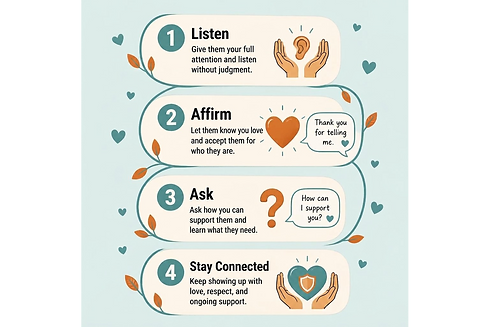
If your child just told you they're transgender, the most important thing you can do first is simple: respond with love, thank them for trusting you, and listen. You don't need to have answers, make any decisions, or fully understand everything right now. Pediatric guidance is consistent that your first response sets the tone, and that calm, warm acceptance is what helps most. Everything else- questions, learning, and any conversations about care- can come later, at your child's pace.
Feeling unprepared, worried, or unsure in this moment is common and doesn't make you a bad parent. What matters most in the first days is that your child feels safe and loved. This page walks through what pediatric and research sources suggest doing first, what you don't need to figure out yet, and where to find support, for your child and for yourself.
You may see this described as gender-affirming care, transition-related care, or supportive care; this page uses "supportive care," and the terms refer to the same thing.
CONTENT NOTE
This is information, not medical advice. Any decisions about care belong to your child, your family, and qualified healthcare providers, and in nearly all cases,
minors cannot receive medical interventions without parental consent. If your child is in immediate danger, call 911; for support any time, call or text 988.
-
Your first response matters most. Pediatric guidance emphasizes that responding with love and listening sets the tone for every conversation that follows. (CHOC)
-
You don't have to decide anything now. Coming out is not a medical decision. Nothing about care needs to be settled today, or any time soon.
-
Let your child lead. Follow their pace and their language, and let them direct who else knows and when. (Children's Hospital of Philadelphia)
-
Acceptance is protective. By age 18, trans people from supportive families had a 22.5% rate of ever attempting suicide, versus 41.5% from rejecting families. (JAMA Pediatrics, 2024)
-
You're not alone. Free organizations like PFLAG support parents through exactly this moment.
KEY TAKEAWAYS
WHAT TO DO FIRST
In the first conversation, lead with love and listening, not questions or solutions. Specific, research- and guidance-backed steps:
THANK THEM AND REAFFIRM YOUR LOVE
A first response that conveys unconditional love makes it safe for your child to keep talking to you. (pediatric psychiatry guidance)
LISTEN MORE THAN YOU SPEAK
Let your child take the lead and share at their own pace; wait until they're ready before asking questions or offering your own thoughts. (CHOC)
STAY CALM, EVEN IF YOU'RE SURPRISED

WHAT YOU DON'T NEED TO DO RIGHT NOW
You do not need to make any medical decisions, have all the language right, or tell anyone else. Coming out is the start of a conversation, not
a deadline.
-
No medical decisions are on the table today. Especially before puberty, clinical guidelines recommend no medical intervention at all; support at that stage is entirely social and psychological, such as names, pronouns, gender expression, and family support. (AAP) And in nearly all cases, minors cannot receive any medical care without parental consent.
-
You don't have to tell anyone. Because coming out is personal, your child should direct who knows, when, and how. Protecting that is part of protecting their safety. (Children's Hospital of Philadelphia)
-
You don't have to have the vocabulary perfect. Willingness
matters more than fluency; your child doesn't need you to be an expert overnight.
WHAT THE RESEARCH SAYS ABOUT WHY THIS MATTERS
How families respond has a measurable, lasting effect on a young person's mental health, and acceptance is strongly protective. A 2024 study in JAMA Pediatrics found that by age 18, the share of transgender people who had ever attempted suicide was 22.5% among those from supportive families, compared with 32.8% from neutral and 41.5% from rejecting families. The same study found that among youth in supportive families, gender-identity milestones were not associated with worse mental health outcomes; acceptance appeared to buffer the risk. None of this requires perfection; it requires warmth and a willingness to stay connected.
One myth worth setting aside early: the idea that a teen coming out is the result of "social contagion" or "rapid onset gender dysphoria" is not supported by clinical evidence; a study of adolescents at a gender clinic found no support for that theory. More young people feeling able to come out reflects greater safety to be open,
not a trend.
REASONABLE NEXT STEPS, WHEN YOU'RE READY
There's no rush, but when you want to move from the first conversation to next steps, a few are worth considering.
-
Keep using their chosen name and pronouns. This is consistently one of the most valued and protective things a parent can do. See our page on how to support a transgender teen.
-
Educate yourself, so it's not your child's job. Reputable parent resources exist for exactly this; our supportive resources page lists trustworthy starting points.
-
Consider a gender-informed therapist or your pediatrician. A qualified professional can support your child and give you a place to process your own questions. Our guide to finding a gender therapist for your teen walks through how.
-
Get support for yourself. PFLAG and Gender Spectrum run free groups for parents. Your wellbeing matters, and it helps you show up for your child.