

WHAT IS "WATCHFUL WAITING" IN GENDER CARE?
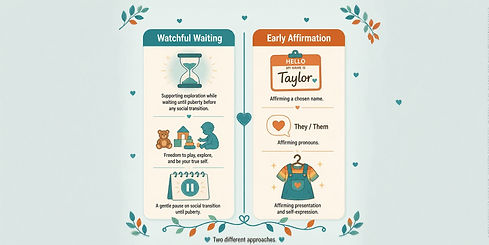
"Watchful waiting" is an older clinical approach to gender-diverse children before puberty. In it, a child is given space to explore their gender and is supported, but is generally not socially transitioned, for example, changing name or pronouns, until puberty, on the reasoning that some young children's gender feelings shift as they grow.
Two things are essential to understand. It applies only to the years before puberty, when no medical treatment is used in any approach. And it concerns the timing of social steps, not medication. Leading US pediatric guidance now regards watchful waiting as outdated, favoring support tailored to each individual child; a more cautious view about early social transition still exists in parts of the field. The term is used in different ways, which is part of why it causes confusion.
Because "watchful waiting" is sometimes presented as simply "the cautious option," it helps to see clearly what it actually refers to, what it does not, and where the genuine disagreement lies. This page explains the term, its origins, the reasoning behind it, how major US medical guidance views it today, and the honest debate that remains.
You may see "watchful waiting" used to mean anything from careful, supportive observation to a stance that discourages any early affirmation; this page uses it in its original clinical sense and flags where meanings diverge.
CONTENT NOTE
This is information, not medical advice, and it explains a clinical term rather than recommending an approach for any child. How to support a particular young person is a decision for that young person, their family, and their qualified healthcare providers. If you are in immediate danger, call 911; for support any time, call or text 988.
-
It's a pre-puberty approach. Watchful waiting concerns gender-diverse children before puberty, not adolescents.
-
It's about social steps, not medication. No medical treatment is used before puberty in any approach; the term is about the timing of social transition.
-
The reasoning was desistance. It was based on older findings that many young children's gender feelings shift by puberty, evidence that is now contested.
-
US guidance considers it outdated. The American Academy of Pediatrics describes watchful waiting as an outdated approach that can withhold needed support.
-
A cautious view persists. Some clinicians and reviews still favor more caution about early social transition, framing it as an open question rather than a settled harm.
KEY TAKEAWAYS
WHAT WATCHFUL WAITING MEANS
Watchful waiting means supporting a gender-diverse child's exploration while holding off on social transition until puberty, rather than affirming a changed name, pronouns, or presentation in early childhood. A peer-reviewed description in Archives of Sexual Behavior summarizes the approach as delaying social gender transition where possible, based on evidence that gender dysphoria frequently shifted in prepubertal children in older studies, and on a concern that a premature social transition might "foreclose" a child's still-developing sense of identity. In this approach, a child is given a safe space to explore gender, but the more visible social steps are generally postponed.
WHERE THE TERM COMES FROM
The term originated with an early clinical protocol for children, often called the Dutch approach. It was described by clinicians de Vries and Cohen-Kettenis as part of a broader model that later became influential internationally. Understanding that origin helps explain why the term is specific: it was a named clinical stance about prepubertal children, not a general synonym for "being careful."
IT'S ABOUT SOCIAL STEPS, NOT MEDICINE
Watchful waiting is frequently misunderstood as meaning "no medical treatment," but that misreads it, because no medical treatment is used before puberty in any model.
The debate watchful waiting belongs to is specifically about whether to support social transition in early childhood, changing name, pronouns, and clothing, before puberty begins. It is not about puberty-pausing medication, which is a separate, later step considered only once puberty has started, after assessment.
So describing watchful waiting as "the option that avoids medication" is inaccurate: medication is not on the table for any young child. For what actually happens once puberty begins, see at what age puberty-pausing medication can begin.
HOW U.S. GUIDANCE SEES IT NOW
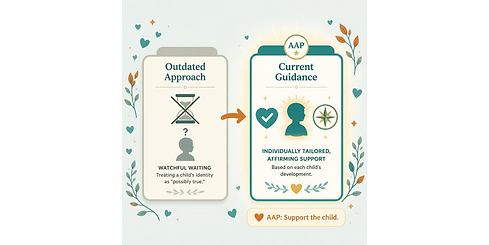
Major US pediatric guidance has moved away from watchful waiting toward individualized, developmentally tailored support. The American Academy of Pediatrics describes watchful waiting explicitly as an "outdated approach" in which a child's gender-diverse assertions are treated as only "possibly true" until some later age, and states plainly that this approach "does not serve the child because critical support is withheld." In its place, the AAP describes individually tailored support based on each child's development. The contrast is summarized below.
THE HONEST DEBATE
There is a genuine, ongoing disagreement about how best to support gender-diverse children before puberty, and it turns on how to weigh uncertain evidence, not on demonstrated harm from either approach. On one side, the reasoning behind watchful waiting rests on older studies reporting that gender dysphoria did not persist into adolescence for a substantial share of prepubertal children, and on the concern that early social transition could shape a child's later identity. That caution about early social transition has also been echoed in some national reviews of the evidence, such as the Cass Review in England, which called for more study of social transition's effects.
On the other side, US pediatric guidance and much recent research emphasize that the desistance figures behind watchful waiting are methodologically contested (they depended heavily on how the studied children were defined), and that disaffirming a child carries its own risks. Research on children with a consistently asserted identity who socially transition finds high persistence and very low rates of later detransition; a five-year study in Pediatrics found 94% of such children still identified as transgender. In other words, the evidence that originally motivated watchful waiting is itself debated, which is a large part of why US guidance has shifted. For more on how consistently young people know their gender, see is my teenager too young to know?
The honest summary: this is an area of real scientific discussion about the best approach under limited long-term evidence, and reasonable clinicians weigh it differently. It is a debate about approach and certainty, not a finding that supporting, or waiting, has been shown to harm children.
WHAT HAPPENS ONCE PUBERTY BEGINS
The prepubertal debate becomes moot once puberty starts, because a different, better-evidenced pathway takes over. When puberty begins, distress often clarifies, and dysphoria that persists and intensifies with puberty is more likely to be durable. At that point, a young person is assessed, and puberty-pausing medication may be considered, a reversible step that provides time.
This "pause" is sometimes loosely described as buying time, but it is a distinct medical concept from prepubertal watchful waiting and involves formal assessment and consent. For how that works, see how trans teens are assessed for care and how gender-affirming care works. For non-medical support at any age, see supporting a trans child without medical steps.