HOW FAMILY SUPPORT AFFECTS
TRANS YOUTH WELLBEING
Family support is one of the strongest factors shaping the well-being of transgender young people. Research consistently shows that trans youth with accepting, supportive families report lower rates of depression, anxiety, and suicide attempts and higher self-esteem than those who face rejection. Support works in doses: the more supportive actions a family takes, the better a young person’s mental health outcomes tend to be.
The reason support helps isn’t complicated. Much of the mental health risk trans youth face comes from stress, rejection, stigma, and bullying. A supportive family helps trans youth cope with that stress. When home is a safe place, a major potential source of daily stress is removed, and well-being improves.
Support does not need to be perfect or immediate to matter. The research suggests even small steps can help.
CONTENT NOTE
This page discusses suicide risk, depression, and anxiety among young people. If you or someone you love needs support right now, the resources are gathered here, and the 988 Suicide & Crisis Lifeline is available 24/7 by call or text.
-
Support is protective. Accepting families are linked to lower depression, anxiety, and suicide risk among trans youth.
-
It works in doses. In national survey data, trans and nonbinary youth with many or all supportive actions from parents reported a past-year suicide-attempt rate that was 8 percentage points lower than those with none or very few supportive actions from parents (11% versus 19%).
-
Small steps count. Each additional supportive action from a parent or caregiver was associated with 6% lower odds of a past-year suicide attempt.
-
Rejection carries real risk. Research links high family rejection to roughly eight times the odds of a suicide attempt in early adulthood.
-
You do not have to be perfect. Support is a direction, not a test. Families learning as they go still make a measurable difference for trans young people.
WHAT THE RESEARCH SHOWS
KEY TAKEAWAYS

HOW, SPECIFICALLY, DOES FAMILY SUPPORT HELP?
Family support helps trans youth's wellbeing in several concrete, research-backed ways. It works by reducing the stress of rejection, affirming a young person’s identity, and keeping them connected to care and community.
-
It buffers minority stress. A supportive home offsets the strain of stigma and discrimination that drives much of the elevated mental health risk trans youth face.
-
It lowers suicide risk during vulnerable moments. A 2024 JAMA Network Open study found that gender identity milestones increased suicide attempt risk for youth in unsupportive homes, while supportive family environments removed that added risk. (Campbell et al., 2024)
-
It improves self-esteem and connection. Family acceptance predicts higher self-esteem, greater social support, and better general health into adulthood. (Family Acceptance Project, Ryan et al.)
-
It keeps care within reach. Supportive families are more likely to help a young person access mental health and other care they need.
WHAT THE RESEARCH SHOWS
The evidence here is consistent across large surveys and peer-reviewed clinical studies. Each figure is a snapshot of a studied group, not a prediction for any individual young person.
SPECIFIC SUPPORTIVE ACTIONS MATTER
Respecting a young person’s pronouns is one concrete example. In the same survey, transgender and nonbinary youth whose pronouns were respected reported an 11% past-year suicide-attempt rate, compared with 17% among those whose pronouns were not respected, about 31% lower odds. (The Trevor Project, 2025)
REJECTION CARRIES A MEASURABLE RISK
The protective effect has a mirror image. Research from the Family Acceptance Project found that LGBTQ young adults who experienced high family rejection as teens were about eight times as likely to report a suicide attempt, and about six times as likely to report high levels of depression, compared with those with little or no rejection. (Ryan et al., via The Trevor Project)
POSITIVE AND NEGATIVE SUPPORT BOTH COUNT
A 2024 study in the Journal of Adolescent Health found that positive family acceptance was associated with fewer emotional and behavioral problems and higher self-esteem, while negative or rejecting responses were associated with worse outcomes, including higher suicidal ideation. Notably, the harm from negative responses was larger in magnitude than the benefit from positive ones, underscoring how much rejection hurts. (Journal of Adolescent Health, 2024)
WHAT SUPPORTIVE ACTION LOOKS LIKE
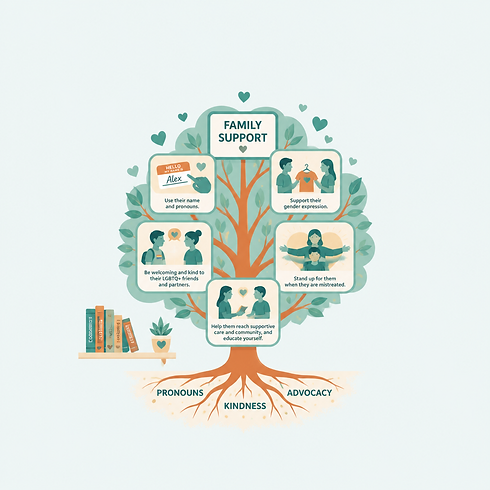
Families often ask what “support” means in practice. Based on what trans and nonbinary young people themselves report, these actions help the most:
-
Using a young person’s name and pronouns, and correcting mistakes without making it their burden.
-
Being welcoming and kind toward their LGBTQ+ friends and partners.
-
Supporting their gender expression, such as clothing or a haircut.
-
Standing up for them when they are mistreated.
-
Helping them reach supportive care and community, and educating yourself so the work does not fall on them.