

TESTOSTERONE SIDE EFFECTS IN TRANS TEENS
Major medical organizations regard testosterone therapy for trans teens as safe and effective when it is medically supervised, and its most noticeable effects are the intended masculinizing changes rather than dangerous complications. Some of those changes, such as a deeper voice and facial hair, are generally permanent, which is part of the point of the treatment. A smaller set of side effects, most notably a rise in red blood cell count, are watched with regular blood tests and are usually manageable by adjusting the dose. The honest limitation is that much of the long-term safety data comes from adults, so teens are followed closely.
This page describes the masculinizing treatment sometimes called gender-affirming hormone therapy, transition-related care, or supportive care; those terms describe the same thing, and this page uses plain clinical language. It covers what to expect and what clinicians monitor, not doses or how to take the medication, which are decisions for a young person and their care team.
CONTENT NOTE
This is information, not medical advice. Whether this medication is appropriate for a particular young person is a decision for that young person, their family, and their qualified healthcare providers, based on individual circumstances.
-
Considered safe with monitoring. Organizations including the Endocrine Society and the American Academy of Pediatrics regard this care as safe and effective when supervised, with regular check-ins and blood tests.
-
Some changes are permanent. Voice deepening and facial hair are generally lasting; that permanence is part of what the treatment is for. Others, like body-fat distribution and periods stopping, largely reverse if testosterone is stopped.
-
A few effects are actively monitored. The most consistently watched is a rise in red blood cell count (erythrocytosis); cholesterol and blood pressure are also tracked.
-
Common early effects are usually manageable. Acne and oily skin are common in the first year and treatable; some teens report pelvic cramping early on.
-
It is not birth control. Periods often stop, but pregnancy is still possible, so contraception matters if that is a possibility.
-
Long-term teen data are still limited. Much of the adverse-effect evidence comes from adults, which is one reason care is closely followed.
KEY TAKEAWAYS
WHAT DOES TESTOSTERONE DO, AND WHAT ARE THE SIDE EFFECTS?
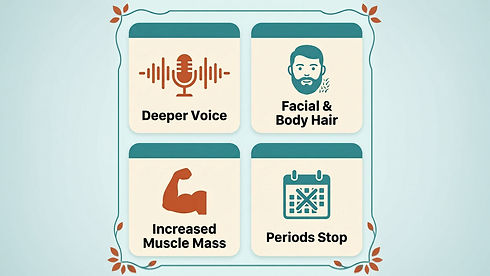
Testosterone produces masculinizing changes and has a small number of monitored side effects. The changes people usually want: deeper voice, facial and body hair, more muscle, and periods stopping. Separately, testosterone can raise the red blood cell count, shift cholesterol, and cause acne, which is why teens on testosterone have regular follow-up and blood work. In one study of transmasculine adolescents, the effects young people reported closely matched the ones they expected before starting (Journal of Pediatric Endocrinology and Metabolism, 2023).
WHAT THE RESEARCH SHOWS
The table groups the main effects by area. Most masculinizing changes appear over the first one to two years, and the monitored side effects are usually caught early through routine blood tests.
Sources: adolescent effects and mental-health context, Gender-affirming medical care of transgender youth (2021); erythrocytosis incidence and monitoring, Annals of Family Medicine (2023) and Journal of Clinical Endocrinology & Metabolism (2021); early pelvic pain, retrospective cohort (2023).
HOW COMMON IS THE MAIN MONITORED EFFECT?
Erythrocytosis, a raised red blood cell count, is the effect clinicians watch most closely because a very high count can raise the risk of blood clots. In one cohort of people on testosterone, over the first 20 months about 12.6% had a hematocrit above 50.4%, while only about 1% crossed the higher 52% threshold and essentially none reached 54% (Annals of Family Medicine, 2023). Guidelines recommend checking blood counts regularly, especially in the first year, and the effect is usually managed by adjusting the dose or switching formulation.
WHAT IS KNOWN, AND WHAT ISN'T
Testosterone’s masculinizing effects and the erythrocytosis risk are well described. The main limitation is that much of the long-term safety data, including effects on the heart and blood pressure, comes from adults rather than from teens followed into adulthood (Gender-affirming medical care of transgender youth, 2021). Alongside the physical effects, studies in both adolescents and adults have linked gender-affirming hormones, including testosterone, to lower rates of depression and improved anxiety, though researchers note the need for more long-term outcome data.