

LEUPROLIDE AND HISTRELIN
Leuprolide and histrelin are two puberty blockers that pause puberty in the same way, so the main difference between them is how they are given rather than how well they work. Leuprolide is an injection repeated every one to six months depending on the formulation, while histrelin is a small implant placed under the skin of the upper arm that lasts about a year. Studies find similar effectiveness and safety, and no one option is considered superior, so the choice usually comes down to practical factors: a preference for avoiding repeated injections, how often a family can get to the clinic, and cost.
This page uses “puberty-pausing medications” for these medicines after the first mention; you may also see them called puberty blockers, GnRH agonists, or GnRH analogues, which describe the same class of treatment.
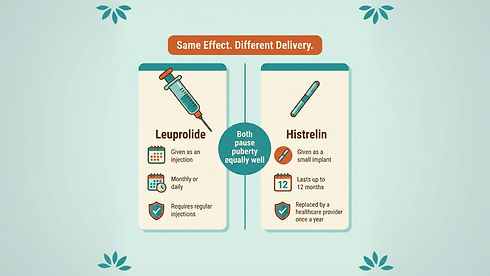
LEUPROLIDE VS. HISTRELIN: WHAT'S THE DIFFERENCE?
Both are GnRH agonists, a class of puberty-pausing medication that lowers the hormone signals driving puberty.
Because they share the same mechanism, they produce the same kind of effect; what differs is the delivery. Leuprolide is given as an injection on a schedule, and histrelin is a once-a-year implant.
A clinical review of the available options concluded that they have similar safety and effectiveness and that no single agent is superior, so selection is based on practical fit rather than one being “stronger” (Frontiers in Pediatrics, 2022).
WHAT THE RESEARCH SHOWS
Sources: options, dosing intervals, and “no superiority,” Frontiers in Pediatrics (2022); implant duration up to
two years, reported from a JCEM study, Medscape (2015); injection routes and intervals, JCEM (2020).
HOW THE IMPLANT IS PLACED
The histrelin implant is a small rod inserted just under the skin of the inner upper arm and replaced about once a year. Insertion and removal are minor procedures. In a large single-center series, the great majority were done under local anesthesia, with general anesthesia used only rarely and mostly for specific circumstances (Journal of Pediatric Surgery, 2014). A separate 10-year institutional review of hundreds of insertions, replacements, and removals reported it to be a well-tolerated routine procedure (Journal of Pediatric Surgery, 2018).
ARE THEY EQUALLY EFFECTIVE AND SAFE?
Broadly, yes. Both suppress puberty hormones effectively, and reviews describe similar safety and effectiveness across the approved options, with the differences lying in convenience rather than potency (Pediatrics, 2005). Because they are the same class of medication, they also share the same class effects, such as a temporary dip in bone density, which we cover on our GnRH agonists and bone-density pages.
HOW THE CHOICE IS MADE
Because neither is clearly better, families and clinicians weigh practical factors: comfort with needles versus a minor procedure, how easily a family can attend clinic visits, the number of procedures over time, insurance coverage and cost, and local availability.
A review of the options frames the decision exactly this way, matching the medicine to the child’s and family’s specific needs rather than ranking the drugs (Frontiers in Pediatrics, 2022).

CONTENT NOTE
This is information, not medical advice. Whether this medication is appropriate for a particular young person is a decision for that young person, their family, and their qualified healthcare providers, based on individual circumstances.