

WHY DID EUROPE RESTRICT
PUBERTY BLOCKERS?
Several European countries, including England, Sweden, and Finland, moved toward greater caution with puberty blockers for young people, generally after their national health authorities reviewed the evidence and concluded that the certainty of the benefits was low. It is important to be precise about what they did and why. These are restrictions on how the care is delivered, typically limiting it to research settings or carefully selected cases, rather than the outright legislative bans passed in some US states, and the care continues in some form. And the reviews concluded that the evidence of benefit was of low certainty, which is a different thing from a finding that the care is harmful. Major US medical organizations, weighing much the same evidence, have reached different conclusions. This page uses "puberty-pausing medication" for the treatment after the first mentions.
These European decisions are often cited in US debate, sometimes accurately and sometimes not, so it helps to see clearly what each country actually did, the reasons its health authority gave, how these steps differ from US state bans, and why US medical bodies weigh the evidence differently. This page lays that out.
This page discusses decisions by European health systems. It is included because those decisions are directly relevant to the evidence discussion in the United States, and they are frequently referenced in it.
CONTENT NOTE
This is information, not medical advice, and it explains a clinical scale rather than any individual's care. Whether and when any medication is appropriate for a particular young person is a decision for that young person, their family, and their qualified healthcare providers, and in nearly all cases minors cannot receive it without parental consent. If you are in immediate danger, call 911; for support any time, call or text 988.
-
Driven by evidence reviews. National health authorities reviewed the research and concluded the certainty of the benefits was low.
-
Restrictions, not bans. These countries limited the care to research or carefully selected cases; they did not prohibit it outright, and it continues in some form.
-
Low certainty is not harm. The reviews found the evidence of benefit to be of low certainty, which is different from finding the care harmful.
-
Different from US state bans. European restrictions came from health-authority evidence reviews; many US state bans are legislative prohibitions.
-
US bodies weigh it differently. Major US medical organizations, reviewing much the same evidence, continue to regard the care as evidence-based.
KEY TAKEAWAYS
WHAT ACTUALLY HAPPENED
In several European countries, national health authorities reviewed the evidence and then narrowed how puberty-pausing medication is provided to young people, generally limiting it to:
Source: Cass Review final report. See the sourcing note in Build Notes regarding the Swedish and Finnish primary documents.
England's changes followed the Cass Review, which we cover in detail on its own page; see what the Cass Review found. Sweden's National Board of Health and Welfare, having previously supported the treatment, updated its guidance in 2022 to recommend that puberty-pausing medication be given only within research or in exceptional, carefully assessed cases. Finland's health authority revised its guidelines in 2020 to emphasize psychosocial support first and to treat medical steps for minors more cautiously. In each case, the care was narrowed rather than abolished, and continues under stricter criteria.
WHY: THE EVIDENCE REVIEWS
The common thread is that each country's health authority commissioned or relied on systematic reviews of the evidence, and those reviews concluded that the certainty of the benefits of puberty-pausing medication and hormones for young people was low. Systematic reviews are a formal way of grading how reliable a body of research is.
In England, Sweden, and Finland, these reviews found that the studies supporting benefit were largely observational and had methodological limitations, and so rated the certainty of the evidence as low or very low.
On that basis, and in some cases weighing that uncertainty against known risks such as effects on bone density, the authorities judged that routine early use was not sufficiently supported and should be restricted.
This is the same evidence-certainty question at the center of the whole debate, examined in more depth on our page on whether gender-affirming care is evidence-based.

THE CRUCIAL DISTINCTIONS: RESTRICTION IS NOT A BAN, AND LOW CERTAINTY IS NOT HARM
Two precise points prevent these decisions from being misunderstood. First, these are restrictions, not prohibitions: the care was limited to research or carefully selected cases, and it continues in those settings, rather than being banned outright. Second, the reviews concluded that the evidence of benefit was of low certainty, which describes the quality
and design of the available studies.
A low-certainty rating is not a finding that the care is harmful or ineffective. Reading "the evidence is low-certainty" as "the treatment was shown to be harmful" misstates what these reviews found.
Both of these distinctions matter, because the European decisions are sometimes described in US debate as bans, or as findings of harm, and they were neither.
HOW THIS DIFFERS FROM US STATE BANS
European restrictions and US state bans came about through different mechanisms and have different effects. The European changes were issued by national health authorities as clinical guidance, after evidence reviews, and they narrowed the care to research or specialist settings while continuing to provide it.
Many US states, by contrast, have passed laws that prohibit this care for minors, which is a legislative ban rather than a clinical guideline, and which typically removes access entirely rather than restricting it to research.
So a European "restriction" and a US "ban" are not the same kind of policy, even when both are described with the shorthand of limiting care.
WHY US MEDICAL BODIES REACH DIFFERENT CONCLUSIONS
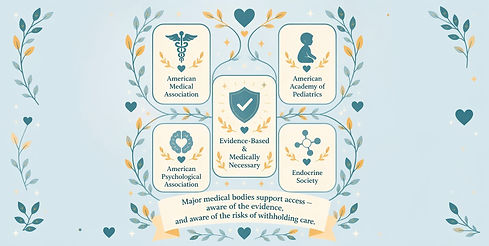
US medical organizations reviewed much the same evidence and weighed it differently, continuing to regard the care as evidence-based and medically necessary. The difference is not that one side has evidence the other lacks; it is that health systems and expert bodies can weigh the same uncertain evidence differently.
US bodies place more weight on the consistency of the observational findings, on decades of clinical experience, and on the risks of withholding care, and they treat observational evidence as an acceptable basis for care when randomized trials are not feasible.
The American Medical Association, American Academy of Pediatrics, American Psychological Association, and Endocrine Society continue to regard this care as evidence-based and medically necessary, and after the Cass Review, the American Academy of Pediatrics reaffirmed its policy and commissioned its own systematic review.
HOW TO READ ALL OF THIS
The most accurate way to understand the European restrictions is as different health systems reaching different judgments about how to act under the same evidence uncertainty, not as proof that the care is harmful.
Reasonable, expert institutions looked at largely the same research and drew different conclusions about the right level of caution. That is a genuine and ongoing disagreement, and it is worth understanding honestly, without flattening it into either "Europe proved this care is dangerous" or "Europe's decisions can be ignored." Neither is accurate.
For the specific evidence questions underneath it, see are puberty blockers safe and gender-affirming care and mental health outcomes.