

HOW LONG ARE PUBERTY BLOCKERS USED?
There is no single fixed length of time that puberty blockers are used; it is individualized, though many young people use them for a few years. The medication is generally used as a pause until the young person, their family, and their care team decide on the next step, either moving to gender-affirming hormones in later adolescence or stopping, at which point the body's own puberty resumes. It is not meant to be indefinite. Some clinicians set an upper limit on how long the medication is used on its own, partly because longer use is linked to lower bone density, so duration is monitored throughout.
The honest answer to "how long" is "it depends," but it depends on specific, understandable things: when the medication was started, the young person's goals, and the decisions made along the way. This page explains the typical duration, what shapes it, the two ways the pause usually ends, and why it is not left open-ended. Throughout, "puberty-pausing medication" refers to the same thing as puberty blockers.
CONTENT NOTE
This is information, not medical advice, and it explains a clinical scale rather than any individual's care. Whether and when any medication is appropriate for a particular young person is a decision for that young person, their family, and their qualified healthcare providers, and in nearly all cases minors cannot receive it without parental consent. If you are in immediate danger, call 911; for support any time, call or text 988.
-
No fixed length. Duration is individualized; many young people use the medication for a few years.
-
It's a pause until a decision. It is generally used until the young person moves to hormones or stops.
-
Two endpoints. The pause typically ends either by starting gender-affirming hormones or by stopping, after which puberty resumes.
-
Not indefinite. Some clinicians cap how long it is used alone, partly due to bone density considerations.
-
It's monitored. Bone health and development are tracked throughout, so duration is a managed part of care.
KEY TAKEAWAYS
HOW LONG ARE PUBERTY-BLOCKING MEDICATIONS USUALLY USED?
Most young people use the medication for a few years, though the exact length varies from person to person. As Mayo Clinic puts it, many people take the medicine for a few years, but everyone is different. The medication itself is given either as an injection lasting one, three, or six months per dose, or as an implant that lasts roughly one to two years before it is replaced. A young person simply continues receiving it, as St. Louis Children's describes, until the family decides what to do next. In practice, many families reach a decision about whether to continue toward hormones within the first year or so of starting.

WHAT DETERMINES HOW LONG THEY'RE USED
A few specific factors shape the duration. These include:
-
When it was started. Beginning in early puberty (around Tanner stage 2) means the pause may cover more of adolescence than starting later. For the timing, see Tanner stages and puberty-pausing medication.
-
The young person's goals and decisions. The medication is a pause that creates time to explore and decide, so how long it is used depends partly on when the young person and family feel ready to take a next step, in either direction.
-
Bone density considerations. Because longer use is associated with lower bone density, clinicians monitor bone health and factor it into how long the medication is used alone. Some set an explicit upper limit; one US pediatric team, for example, recommends using puberty-pausing medication alone for a maximum of about four years, with bone density scans and vitamin D and calcium monitored throughout. For details, see puberty blockers and bone density.
HOW THE PAUSE USUALLY ENDS
The pause typically ends in one of two ways, and both are planned decisions made with the care team.
Sources: Mayo Clinic; peer-reviewed cohort in medRxiv/PMC (2025).
As Mayo Clinic explains, after delaying puberty for several years, some teens decide to stop the medication, while others move on to hormones that match their gender identity. When the medication is stopped, puberty resumes; a 2025 peer-reviewed analysis notes that after the medication is discontinued, the body's own hormone system typically resumes function within about 6 to 12 months. For the fuller sequence of steps, see the steps of medical transition.
IS IT CONTINUED AFTER HORMONES BEGIN?
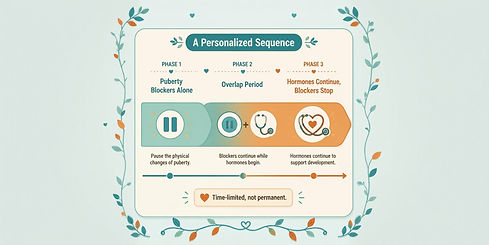
Sometimes the medication is continued for a time alongside gender-affirming hormones, then stopped, rather than being used indefinitely.
When a young person begins hormones, the puberty-pausing medication may be kept on for a while to continue suppressing the body's own puberty while the new hormones take effect, and is later discontinued.
The details are individualized and decided by the care team. The point is that the medication is a time-limited part of care, not a permanent treatment.
WHY ISN'T IT USED INDEFINITELY?
Puberty-pausing medication is designed as a pause that buys time, not a permanent state, and there are good reasons it is not left open-ended. The main one is bone health: puberty is when the body builds much of its adult bone, and pausing that for too long is linked to lower bone density, which is why clinicians monitor it and limit how long the medication is used alone. Leaving a young person in a low-hormone state longer than needed is specifically avoided. This is part of why care moves, in time, either toward hormones or back to the body's own puberty, rather than staying paused indefinitely. For how bone health is tracked and protected, see puberty blockers and bone density.