

QUESTIONS TO ASK AT A GENDER CLINIC
Good questions to ask a gender clinic fall into a few clear groups: how the assessment process works, what options are actually on the table (including non-medical ones), the risks, benefits, and alternatives of anything proposed, how the clinic approaches care, and the practical logistics of cost, timing, and consent.
You don't need to be an expert to ask them, and a good clinic will welcome them. Coming in with a written list helps you get the information you and your child need to make decisions together, which is exactly how quality care is designed to work.
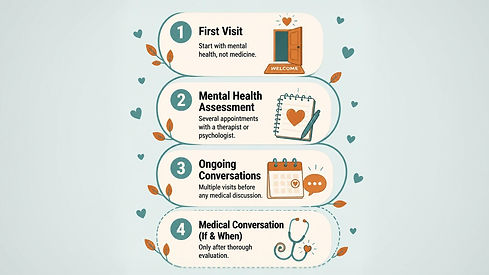
A first visit is usually about getting to know each other, not making immediate decisions. At most US pediatric gender clinics, the initial appointments are an assessment and an education conversation, where the team explores your child's goals and explains options, rather than a fast track to any treatment. The questions below help you understand that process and judge whether a clinic's approach is careful, transparent, and a good fit.
You may see these clinics described as gender clinics, gender programs, or gender and sexuality development clinics; this page uses "gender clinic" for simplicity, and "supportive care" for the range of services they discuss.
CONTENT NOTE
If your teen is in crisis or thinking about suicide, help is available right now. Call or text 988 (the 988 Suicide & Crisis Lifeline). For more, see our where to get help page.
-
Ask how the assessment works. Quality care starts with a careful, multi-step evaluation, not an immediate prescription.
-
Ask about all the options, including non-medical ones. Good informed consent means a full discussion of options, risks, benefits, and alternatives. (research on informed-consent quality)
-
Ask about the clinic's approach. You want a team that is discerning and neutral, exploring your child's individual needs, not projecting its own views. (detransition-care research)
-
Ask about logistics. Cost, insurance, timing, and who needs to consent are fair, important questions. (CHOP gender clinic)
-
Write them down. Clinics themselves recommend bringing a written list so nothing gets missed. (CHOP)
QUESTIONS ABOUT THE ASSESSMENT PROCESS
Start by understanding how the clinic evaluates your child, because careful assessment is the foundation of good care. At most US pediatric clinics, the first visits are with a mental health provider and involve several appointments before any medical conversation. Useful questions:
What happens at the first appointment, and how many visits does the assessment usually take?
Who will be involved: mental health professionals, an adolescent medicine doctor or endocrinologist, a social worker?
What a good answer sounds like: a clear, multi-step process with a team, in which assessment and education come before any treatment decision, not a same-day prescription.
QUESTIONS ABOUT OPTIONS, RISKS, AND BENEFITS
Ask the clinic to lay out the full range of options, and the risks, benefits, and alternatives of each, because that is what genuine informed consent requires.
Research on people's care experiences finds that quality informed consent means robust discussion of a range of treatment options and their known risks and benefits, and that thin or one-sided discussions are a real complaint. Useful questions:
-
What are all the options here, including social and non-medical support, not just medication?
-
For anything you'd propose, what are the benefits, the risks and side effects, and the alternatives?
-
What is reversible, what is not, and what is still uncertain in the evidence?
-
What happens if we choose to wait, or to do nothing medical right now?
-
How are decisions made, and how are my child and I involved at each step?
What a good answer sounds like: an even-handed walk-through of options (including doing nothing medical), honesty about uncertainty, and decisions shared among your child, your family, and the team.
QUESTIONS ABOUT THE CLINIC'S APPROACH
Ask how the clinic thinks about care, because the right posture is neutral, individualized, and non-pressuring in either direction. When researchers asked people who had stopped or reversed a transition what they'd wanted, many described a preference for a discerning, "neutral" approach that explores individual needs and avoids providers projecting their own views of gender. Useful questions:
How would you describe your philosophy of care for young people and families?
How do you handle uncertainty, or a young person who is still exploring?
What a good answer sounds like: a team that neither rushes nor obstructs, that treats your child as an individual, and that makes mental health support available alongside, separate from, gatekeeping.
QUESTIONS ABOUT THE CLINIC'S ENVIRONMENT
Ask practical questions about how your child will be treated day to day, because a welcoming environment measurably affects wellbeing. In one study of parents accessing care, several noted that being misgendered by providers or office staff negatively affected their children. Useful questions:
-
Will staff use my child's chosen name and pronouns, including in records and at the front desk?
-
Does the team have specific training and experience with gender-diverse young people?
-
How do you protect privacy and confidentiality?

QUESTIONS ABOUT LOGISTICS, COST, AND CONSENT
Get the practical details clear early; they matter, and you're entitled to ask. Clinics routinely handle these upfront; CHOP, for example, confirms insurance and provides any out-of-pocket costs before scheduling. Useful questions:
-
What will this cost, what does our insurance cover, and what are the out-of-pocket amounts?
-
What are the wait times for a first visit and between steps?
-
Do you offer telehealth, and is that an option for us?
-
What consent is required, and how do you handle parental consent and my child's involvement?
On that last point: in nearly all cases, minors cannot receive medical care without parental consent, and good clinics build shared decision-making with youth and families into the process.
A QUICK WORD ON TIMING
Don't feel you must ask everything at once, or decide anything on day one. A first appointment is an opportunity for you and the clinic to learn about each other and for your questions to be answered, not a deadline. Bring your written list, ask what you can, and know you can follow up.
For finding the right clinic or therapist in the first place, see our guide to finding a gender therapist for your teen.