

WHAT IS SOCIAL TRANSITION?
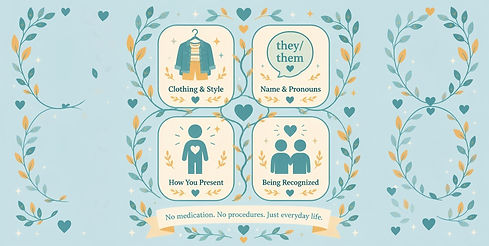
Social transition is the non-medical, everyday way a person lives in their gender. It can include using a chosen name and pronouns, dressing and styling in ways that feel right, coming out to others at one's own pace, and sometimes updating documents or records. It involves no medication and no medical procedures. It is reversible, and it is available at any age. In fact, it is the main way young children are supported, because there are no medical steps before puberty. Research links this kind of support to better mental health for young people.
Understanding social transition clears up one of the most common points of confusion in this area: the difference between the everyday, social side of support and the medical steps that some older adolescents consider. This page explains what social transition is, what it can include, what the research shows, and how it differs from medical care.
CONTENT NOTE
This is general information, not personal medical advice. Whether this medication is appropriate for a particular young person is a decision for that young person, their family, and their qualified healthcare providers, and in nearly all cases minors cannot receive it without parental consent. If you are in immediate danger, call 911; for support any time, call or text 988.
KEY TAKEAWAYS
-
It's the non-medical side of support. Social transition means living in one's gender through name, pronouns, and expression, with no medication.
-
It's reversible. Because it involves no medical steps, a social transition can be changed again if a person's understanding of themselves changes.
-
It's available at any age. For children before puberty, it is the only form of support used.
-
Research links it to better mental health. Studies associate supported social transition with mental health closer to that of peers.
-
It's individualized. Not everyone does every part, and people move at their own pace.
WHAT SOCIAL TRANSITION IS
Social transition is the set of non-medical, everyday steps through which a person lives as their gender.
Researchers describe it plainly: a social transition involves presenting to others in one's gender in everyday life, such as through clothing and pronouns, as defined in a 2017 study in the Journal of the American Academy of Child & Adolescent Psychiatry.
The defining feature is that it is entirely social and psychological. It involves no medication and no medical procedures.
It is simply the everyday business of being recognized and treated as one's gender.
WHAT SOCIAL TRANSITION CAN INCLUDE
Social transition covers a range of everyday steps, and people take the ones that fit them.
-
Name: Using a chosen name
-
Pronouns: Using pronouns that fit, such as he, she, they, or others
-
Expression: Clothing, hairstyle, and presentation that feel right
-
Coming out: Sharing one's gender with family, friends, or school, at one's own pace
-
Documents: Sometimes, updating a name or gender marker on records, where a family chooses to
Sources: Durwood et al. (Journal of the AACAP, 2017); American Academy of Pediatrics (2018); Endocrine Society (patient guidance).
IT IS NONMEDICAL AND REVERSIBLE
Social transition involves no medical treatment, and because of that, it is reversible. There is no medication or procedure involved, so a young person can change their name, pronouns, or presentation again if their understanding of themselves changes.
This is also why it is the only form of support used for children before puberty: as the American Academy of Pediatrics and the Endocrine Society describe, no medical intervention is used before puberty, so support at that stage is entirely social and psychological.
For a fuller look at the non-medical side of support, see supporting a trans child without medical steps.
WHAT THE RESEARCH SHOWS
Research associates supported social transition with better mental health, though the studies describe associations rather than proven causation.
A 2016 US study in Pediatrics found that socially transitioned transgender children who were supported in their identity had developmentally normative levels of depression and only minimal elevations in anxiety, which the authors said suggests that mental-health difficulties are not inevitable for these children. Because the families in that study were already supportive and chose to take part, the finding is an association, not proof that social transition causes better mental health.
Related research links specific supportive steps to better outcomes: updating identification documents has been associated with lower rates of suicidality among trans and nonbinary youth, and The Trevor Project reports that young people whose pronouns are respected by those they live with attempt suicide at lower rates.
These are consistent associations, and they point in the same direction: being supported helps.
DOES A SOCIAL TRANSITION USUALLY LAST?
For most young people who socially transition, it does, though a small share change course, which social transition's reversibility accommodates.
A 2022 study in Pediatrics followed 317 youth for an average of about five years after a childhood social transition and found that 94% still identified as transgender, while a small share had retransitioned; the authors concluded that retransitions are infrequent. They also noted that later cisgender identities were somewhat more common among children who transitioned very young, before age 6.
Because social transition is non-medical and reversible, it can accommodate a change of course if one happens. For more on how consistently young people know their gender, see: Is my teenager too young to know? and for the discussion about timing in young children specifically, see what watchful waiting is.
SOCIAL TRANSITION AND MEDICAL STEPS
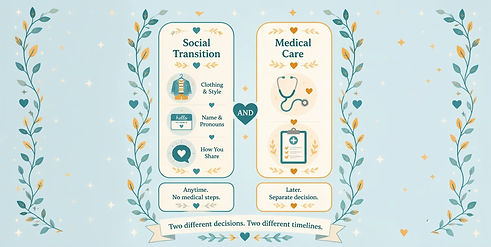
Social transition is separate from medical care, and the two are different decisions on different timelines. Social transition is non-medical and available at any age.
Medical steps, when they are considered at all, only apply to adolescents, come later, and are separate decisions made with qualified providers and, for minors, parental consent.
Many young people's care is entirely social and never medical.
For how the steps fit together, see the steps of medical transition, and for the overall model, how gender-affirming care works.