

HOW TO TALK TO YOUR TEEN ABOUT GENDER
The best way to talk to your teen about gender is to lead with curiosity, not conclusions: ask open-ended questions, listen more than you advise, and keep the pressure low. You don't need a perfect script or all the right words. Pediatric guidance consistently emphasizes that teens value being heard over being given solutions, and that a calm, judgment-free tone is what keeps the conversation going. These talks work best as an ongoing, everyday thing, not one big, high-stakes "talk."
It's normal to feel unsure, or even to worry you'll say the wrong thing. That feeling is nearly universal among parents here, and it doesn't disqualify you from having a good conversation. What matters most is that your teen feels safe and loved. This page offers practical, research-informed ways to open and hold these conversations well.
You may see this area described using terms like gender identity, gender expression, and supportive care; this page keeps to plain language and defines terms as they come up.
CONTENT NOTE
If your teen is in crisis or thinking about suicide, help is available right now. Call or text 988 (the 988 Suicide & Crisis Lifeline). For more, see our where to get help page.
-
Ask, then listen. Open-ended questions and genuine listening matter more than having answers. Teens often want to be heard, not fixed. (Sharp HealthCare)
-
It's okay not to know. Admitting you don't understand, while reaffirming your love, builds trust rather than eroding it. (Sharp HealthCare)
-
Small, everyday moments beat one big talk. Use natural openings rather than staging a single high-pressure conversation. (Hackensack Meridian Health)
-
A judgment-free space is the foundation. Teens open up when they know the conversation is safe from punishment or ridicule. (The Kids Mental Health Foundation)
-
Warmth is protective. Family acceptance is strongly linked to better mental health for trans youth.
(JAMA Pediatrics, 2024)
KEY TAKEAWAYS
START WITH THE RIGHT POSTURE
Before the words, the posture. Come in curious and calm, not with a verdict or an agenda. A board-certified pediatrician's core advice is to ask open-ended questions, admit when you don't understand, and ask how you can show love and support. Often, parents rush to offer solutions when what a teen needs is to be heard. Setting a safe, judgment-free tone is what makes a teen willing to speak freely. (The Kids Mental Health Foundation)
HOW TO OPEN THE CONVERSATION
The easiest openings are low-key and specific, tied to everyday moments rather than a summoned sit-down. Practical approaches drawn from clinical guidance:
-
Use natural cues. If your teen has a new haircut or style, you can gently open with something like "Tell me more about that", a real example suggested by a pediatric specialist. (Hackensack Meridian Health)
-
Ask, don't quiz. Open-ended prompts ("Help me understand how you see things," "What do you need from me?") invite sharing; yes/no or leading questions shut it down. (Hackensack Meridian Health)
-
Let low-stakes moments carry it. Conversations in the car, at dinner, or while doing something side by side often feel safer to a teen than a face-to-face "we need to talk." (FamilyEducation)

WHAT TO DO WITH YOUR FEELINGS
You're allowed to have feelings, including confusion or worry, and you can be honest about them without making them your teen's burden. Pediatric guidance suggests it's fine to say you're struggling with your feelings while reassuring your child of your love and acceptance. Phrases like "Help me understand how you see things" turn your own uncertainty into connection. If you need time, say so and reaffirm your love in the same breath. Getting your own support, from a therapist or a group like PFLAG, helps you show up steadier.
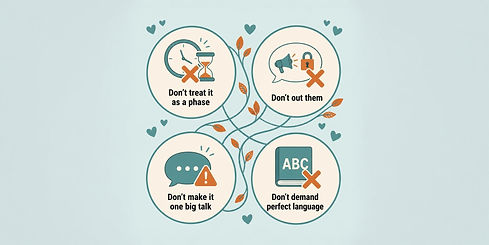
A FEW THINGS TO AVOID
A handful of easy missteps can close a conversation; steering around them keeps the door open.
DON'T TREAT IT AS A PHASE TO WAIT OUT
Questions that signal disbelief tend to end the conversation. Following your teen's lead is what the guidance recommends.
WILLINGNESS MATTERS MORE THAN FLUENCY
DON'T MAKE IT ONE ENORMOUS TALK
Ongoing, low-pressure check-ins work better than a single loaded event.
HOW TO LISTEN WELL
Listening well means resisting the urge to fix and letting your teen lead. Guidance from a clinical psychologist who specializes in adolescents stresses listening without trying to immediately solve the problem; sometimes a teen simply needs a supportive listener. Concretely:
-
Let your teen set the pace and the vocabulary; follow their lead rather than steering.
-
Validate the feeling even while you're still learning the concepts ("Thank you for telling me; that took trust").
-
Ask what they need from you, rather than assuming.
WHY THESE CONVERSATIONS MATTER
Warm, accepting communication isn't just nice; it's linked to measurably better outcomes. A 2024 study in JAMA Pediatrics found that by age 18, trans people from supportive families had far lower lifetime suicide-attempt rates (22.5%) than those from rejecting families (41.5%), and that in supportive families, gender-identity milestones weren't associated with worse mental health outcomes at all. You don't have to get every conversation perfect; staying warm and connected is the thing that protects.