

HOW TO FIND A GENDER THERAPIST FOR MY TEEN
To find a gender-affirming therapist for your teen, start with a reputable directory that lets you filter for gender identity experience, check that the provider is licensed in your state and trained to work with gender-diverse young people, and ask a few direct questions before committing. If in-person options near you are thin, telehealth widens the pool considerably. Finding the right fit can take some effort; provider shortages are real, but it is doable, and a good match makes a meaningful difference.
A gender-competent therapist doesn't try to change your teen's gender; they provide a safe, knowledgeable space for your teen to explore their identity, work through any distress, and think about next steps. This page walks through where to look, how to vet a provider, what to ask, and what to do if you're in an area with few options.
You may see this described as gender-affirming therapy, LGBTQ-affirming therapy, or supportive care; this page uses "gender therapist" and "gender-affirming therapist" interchangeably for a mental health professional experienced with gender-diverse young people.
CONTENT NOTE
If your teen is in crisis or thinking about suicide, help is available right now. Call or text 988 (the 988 Suicide & Crisis Lifeline). For more, see our where to get help page.
-
Use a reputable directory. Filter for gender identity or LGBTQ+ experience. Psychology Today's directory has a transgender/gender identity filter. (Psychology Today)
-
Check licensing and training. A therapist can only see clients in states where they're licensed; look for gender-specific training. (FOLX guide)
-
Ask direct questions. Experience with trans clients, use of pronouns, and approach to gender are fair to ask before you commit. (JED Foundation)
-
Telehealth helps if local options are limited. Many families can't find a nearby provider; a licensed telehealth therapist expands the pool. (research on access barriers)
-
Local LGBTQ centers and PFLAG can refer you. They often keep vetted lists of affirming providers. (FOLX)
KEY TAKEAWAYS
WHERE TO LOOK
Start with directories and local organizations that specialize in affirming care; they do the first layer of filtering for you.
ONLINE DIRECTORIES
Psychology Today's directory lets you filter for transgender/gender identity experience by location and insurance. Insurance-based platforms like Grow Therapy offer similar LGBTQ+ filters.
LOCAL LGBTQ CENTERS AND PFLAG
These groups often keep referral lists of vetted affirming providers and know the local system well. Our supportive resources page lists places to start.
NETWORKS FOR SPECIFIC COMMUNITIES
The National Queer & Trans Therapists of Color Network offers a directory focused on queer and trans people of color.
LOCAL LGBTQ CENTERS AND PFLAG
These groups often keep referral lists of vetted affirming providers and know the local system well. Our supportive resources page lists places to start.
WHAT TO LOOK FOR IN A PROVIDER
Look for genuine training and experience with gender-diverse youth, not just a "friendly" label. Signs of a good fit, drawn from clinician guidance:
-
Stated experience and training. Affirming therapists usually list their LGBTQ+ and gender-related training, certifications, and often their pronouns.
-
Licensed in your state. A therapist can only work with clients in states where they hold a license; this matters especially for telehealth. (FOLX)
-
Signs of open-mindedness in their bio. Look for curiosity, inclusivity, and specific mention of work with queer or trans youth.
-
An affirming, non-coercive approach. A gender-affirming therapist centers on supporting your teen's exploration rather than trying to change their identity, and doesn't push in any direction.

QUESTIONS TO ASK BEFORE YOU COMMIT
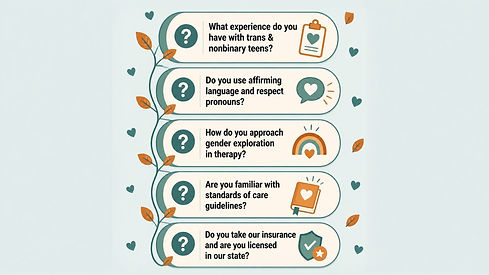
A short call or first session is the place to check fit, and a confident, non-defensive answer is a good sign. Useful questions, adapted from clinician guidance:
What experience and training do you have working with transgender and nonbinary teens?
Do you use gender-affirming language and respect pronouns?
If a provider is dismissive or unsure in response to these, that can be a red flag. You're allowed to talk to more than one before choosing.
IF OPTIONS NEAR YOU ARE LIMITED
If you can't find a good in-person therapist nearby, you're not stuck; this is a common problem with real workarounds. Research on families accessing care found that providers are hard to find, especially outside cities and academic medical centers, leaving much of the country underserved. Options that help:
-
Telehealth. A licensed telehealth therapist can reduce the geographic barrier, as long as they're licensed in your state; check that your insurance covers it. (JED Foundation)
-
Waitlists and referrals. If a good-fit therapist isn't taking new patients, ask to join a waitlist or for a referral to another affirming provider; they know the local system best.
-
Low-cost options. Community LGBTQ centers sometimes offer low-cost or free therapy, or curated referral lists. Cost is a real barrier; more than a quarter of trans people in one national survey went without care in the past year due to cost, so it's worth asking about sliding-scale fees.
A NOTE ON YOUR TEEN'S COMFORT
Your teen's sense of safety with the therapist matters as much as credentials, so involve them in the choice.
Notably, research finds that trans and nonbinary youth are often more willing to talk to a counselor than to parents or teachers about mental health concerns, so the right therapist can be a uniquely valuable support.
Let your teen weigh in on the fit, and give it a session or two before deciding. For the wider picture of support, see how to support a transgender teen.
CONTENT NOTE
This is information, not medical advice, and isn't an endorsement of any specific provider or directory; always verify a therapist's credentials, licensing, and fit for your family. Decisions about care belong to your teen, your family, and qualified providers, and in nearly all cases minors cannot receive medical care without parental consent. If your teen is in immediate danger, call 911; for support any time, call or text 988.