

HOW DOES GENDER-AFFIRMING CARE WORK?
Gender-affirming care works as a staged, individualized process, not a single treatment or a fast track to surgery. For a young person, it begins with assessment and support, and much of it, especially for children before puberty, is entirely non-medical: using a chosen name and pronouns, counseling, and family support. If and when medical steps are considered, they follow puberty in a careful order: puberty-pausing medication first, then hormones for older adolescents. Each has its own evaluation, informed consent, and, for minors, parental consent. Genital surgery is generally not part of care for minors. Every step is made together by the young person, their family, and a qualified medical team.
The phrase gender-affirming care covers a wide range of support, most of it social and psychological rather than medical, and the process is deliberately gradual, with assessment and shared decision-making at each stage. This page walks through the whole model in plain language: what the care actually includes, who provides it, how the stages work by age and pubertal development, what the assessment involves, and what the care does and does not do.
You may see this called gender-affirming care, transition-related care, or supportive care; this page uses "supportive care" for clarity after the first mentions, and the terms describe the same thing.
CONTENT NOTE
If your teen is in crisis or thinking about suicide, help is available right now. Call or text 988 (the 988 Suicide & Crisis Lifeline). For more, see our where to get help page.
-
It is a process, not one procedure. Supportive care is a staged pathway of assessment, support, and, sometimes, medical steps, individualized to each young person.
-
Most of it is non-medical. Especially before puberty, care is social and psychological only: name, pronouns, counseling, and family support, with no medical intervention.
-
Medical steps are staged and follow puberty. When appropriate, puberty-pausing medication comes first, then hormones for older adolescents. The order is deliberate.
-
Surgery is not part of care for young children, and genital surgery is generally not done on minors. Major guidelines reserve genital surgery for adulthood.
-
Decisions are shared and consented. A medical team, the young person, and, for minors, parents decide together, with assessment and informed consent at each step.
-
Leading US medical bodies support it. The AMA, AAP, APA, and Endocrine Society regard this care as evidence-based and medically necessary.
KEY TAKEAWAYS
What "supportive care" actually includes
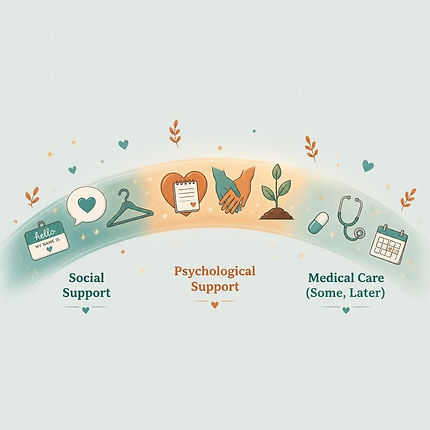
Supportive care is a broad spectrum of support, and much of it has nothing to do with medication or surgery. It ranges from social and psychological support to, in some cases and at appropriate ages, medical care. Understanding that range is the key to understanding how the care works, because the image of it as primarily surgical is inaccurate, especially for young people.
The spectrum generally includes social support (using a young person's name and pronouns, clothing, and expression), psychological support (counseling and a steady, accepting environment), and, for some adolescents, medical care that follows puberty. A 2024 scoping review in BMC Medical Ethics describes care for young people as typically relying on a multi-step informed-consent process and shared decision-making involving youth and their families. For a fuller look at the non-medical side, see our page on supporting a trans child without medical steps.
Who provides the care?
Supportive care is delivered by a multidisciplinary team, not a single prescriber. The Endocrine Society's clinical practice guideline describes care involving appropriately trained diagnosing clinicians, a mental health provider (required for adolescents), and clinicians experienced in this area who stay involved throughout.
In practice, a team may include a pediatrician or adolescent medicine doctor, a mental health professional, and, where medical steps are considered, a pediatric endocrinologist, alongside the family.
This team structure is part of why the process is gradual and carefully checked at each stage. For what a first visit is actually like, see questions to ask a gender clinic.
How the care works, stage by stage
Medical care is organized around pubertal development, not a fixed age, and moves through clear stages: before puberty, early puberty, and later adolescence. Nothing is rushed, and each stage has its own criteria.
BEFORE PUBERTY
No medical treatment is used. The Endocrine Society recommends against puberty suppression before puberty has begun; what is indicated at this stage is acceptance and affirmation of the child's gender, meaning entirely social and psychological support. Any idea that young children are given medication or surgery is a misunderstanding of how the care works.
EARLY PUBERTY
Once puberty has started, at around Tanner stage 2, puberty-pausing medication (a GnRH agonist) may be considered to pause the development of unwanted secondary sex characteristics and give a young person time. The effect is reversible: if the medication stops, the body's own puberty resumes. Families often ask how long this stage lasts. It is individualized, and it is used as a pause rather than an indefinite state. For details, see our pages on what puberty-pausing medication is and whether it is reversible.
LATER ADOLESCENCE
Gender-affirming hormones (estrogen or testosterone) may be considered for older adolescents. Per the Endocrine Society guideline, hormones are added only after a multidisciplinary team has confirmed that gender dysphoria has persisted and that the young person has sufficient capacity to give informed consent. The guideline notes most adolescents reach this capacity by about age 16. This is a more significant, partially irreversible step, which is why the assessment before it is thorough. See testosterone therapy and estrogen therapy for what each involves.
HOW YOUNG PEOPLE ARE ASSESSED
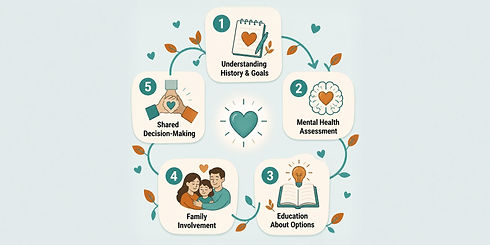
Assessment is a careful, multi-session process, not a single appointment, and it centers on understanding the young person before any medical step.
In practice, the initial visits may take several sessions: understanding the young person's history and goals, assessing mental health, providing education about options, and involving the family throughout. For minors, adolescents provide informed assent and parents or guardians provide consent. In nearly all cases, medical care cannot proceed without it. This is where shared decision-making happens: the process is designed so that the young person, their family, and the team reach decisions together rather than any one party deciding alone. For how to find the right clinician, see how to find a gender therapist for your teen.
WHAT THE CARE DOES NOT DO
Several common impressions of the care are simply inaccurate, and correcting them is part of explaining how it actually works.
-
It does not medicalize young children. Before puberty, care is social and psychological only, with no medication or surgery.
-
It does not perform genital surgery on minors. Analysis of clinical guidelines confirms that genital surgery is not considered for minors. Chest surgery may be considered case-by-case for some transmasculine adolescents, weighing risks and benefits individually. Genital surgery is reserved for adulthood.
-
It is not rushed. The staged structure, multi-session assessment, and requirement for persistence and informed consent are all designed to slow the process down, not speed it up.
-
It is not one-size-fits-all. Each stage depends on the individual young person's development, goals, and readiness, decided with their team and family.
WHO SUPPORTS THIS MODEL OF CARE?
This staged model is endorsed by the major US medical and mental health organizations. The American Medical Association, American Academy of Pediatrics, American Psychological Association, and Endocrine Society regard this care as evidence-based and medically necessary, and hold that decisions belong with young people, their families, and their physicians. The Endocrine Society develops its guidance through a multi-year, rigorously reviewed process open to comment from its more than 18,000 members.
There is genuine scientific discussion about the certainty of parts of the evidence base, particularly on long-term outcomes, which independent reviews have examined. That discussion is about how strong the evidence is, not a finding that the care is harmful, and it is covered honestly on our evidence pages, including what the research shows about safety. It does not change the staged structure described here, which is the model these organizations support