

IS MY TEENAGER TOO YOUNG TO KNOW
THEY ARE TRANS
No, a teenager is generally not too young to have a real sense of their gender. According to the American Academy of Pediatrics, children who assert a transgender or gender-diverse identity tend to know their gender as clearly and as consistently as their peers who are cisgender, and by adolescence that sense is typically well-formed. That doesn't mean every young person's understanding is fixed forever; gender identity develops over childhood and into adolescence, but "too young to know" is not what the research supports. Taking your teen seriously and staying connected is both the evidence-based and the safest response.
It's a caring question to ask; worrying whether your teen truly knows is part of wanting to get this right. This page lays out what the research actually shows about how consistently young people know their gender, the honest nuances, and why respect and support don't require you to have certainty about the future.
You may see this discussed using terms like gender identity, gender dysphoria, and supportive care; this page keeps to plain language and defines terms as needed.
CONTENT NOTE
If your teen is in crisis or thinking about suicide, help is available right now. Call or text 988 (the 988 Suicide & Crisis Lifeline). For more, see our where to get help page.
-
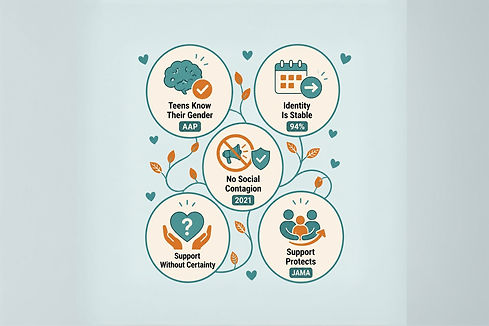
Teens generally know. Per the AAP, young people who assert a trans identity know their gender about as clearly and consistently as their cisgender peers. (American Academy of Pediatrics)
-
Identity is usually stable by adolescence. In a 5-year study, 94% of youth who socially transitioned in childhood still identified as transgender. (Pediatrics, 2022)
-
"Social contagion" isn't supported. Clinical evidence does not back the "rapid onset gender dysphoria" theory. (clinical study, 2021)
-
You don't need certainty to be supportive. Respect and connection help regardless of what the
future holds.
-
Support is protective either way. Family acceptance is strongly linked to better mental health.
(JAMA Pediatrics, 2024)
KEY TAKEAWAYS
WHAT THE RESEARCH SAYS ABOUT HOW WELL YOUNG PEOPLE KNOW
The evidence indicates that adolescents generally have a genuine, reasonably stable sense of their gender, not a passing confusion. The American Academy of Pediatrics states that children who assert a transgender or gender-diverse identity know their gender as clearly and as consistently as their developmentally matched cisgender peers. Research using implicit measures, which operate outside conscious awareness and are harder to fake than self-report, found that transgender children's gender identity is deeply held rather than the product of confusion or pretense. By the teen years, that sense is generally more settled still.
DOES IT USUALLY LAST?
For most young people, yes, especially once identity is asserted in adolescence. The largest study of its kind, published in Pediatrics in 2022, followed 317 youth for an average of five years after a childhood social transition and found that 94% still identified as binary (meaning boy or girl) transgender, with 2.5% identifying as cisgender and 3.5% as nonbinary. The researchers concluded that detransitions are infrequent and that youth who transitioned early most often continued to identify that way.
One honest nuance, which actually cuts toward reassurance for a parent of a teen: the study found later cisgender identities were somewhat more common among children whose social transition happened very young, before age 6. In other words, the younger-child picture carries a bit more fluidity than the adolescent one, and a teenager's asserted sense of gender is, if anything, on firmer footing than a very young child's.
WHAT ABOUT "SOCIAL CONTAGION" OR A SUDDEN PHASE?
The idea that teens declare a trans identity because of peer influence or social media, sometimes called "rapid onset gender dysphoria", is not supported by clinical evidence.
A study of adolescents seen at gender clinics found no support for the theory; the factors it predicted were either not significant or ran in the opposite direction.
A separate critical analysis found that 71.3% of teens said to have "rapid onset" had never been told they needed to transition to be happy, and that only about 1% had detransitioned, undercutting the peer-pressure premise.
More young people coming out today largely reflects greater safety to be open, and transgender people remain less than 1% of the population.
WHY YOU DON'T NEED CERTAINTY TO RESPOND WELL
Supporting your teen doesn't require you to predict the future; it requires taking them seriously now. Gender identity does develop through childhood and adolescence, and a small share of young people's understanding shifts over time. But responding with respect, using the name and pronouns they ask for, and staying connected are helpful regardless of how things unfold, and they carry no downside if a teen's understanding later changes. What does carry risk is dismissiveness: family rejection and invalidation are linked to worse mental health outcomes, while family acceptance is strongly protective. You can hold openness about the future and full respect in the present at the same time.
WHAT THIS MEANS FOR THE NEXT STEPS
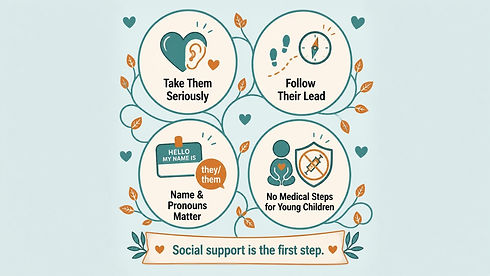
Take your teen seriously, follow their lead, and remember that respect is not the same as any medical decision. Social support- name, pronouns, expression- is exactly what's recommended, and for younger children there are no medical interventions at all. Any medical step is a separate, later decision made with your teen and qualified providers, and in nearly all cases requires parental consent. For how to put support into practice, see how to support a transgender teen; if you're still forming your own view, our guidance for parents who feel unsure may help.