

TANNER STAGES & PUBERTY BLOCKERS
The Tanner stages are a standard five-point scale that clinicians use to describe how far physical puberty has progressed, from Tanner stage 1 (before puberty) to Tanner stage 5 (fully developed). Their connection to puberty blockers is direct and specific: puberty-pausing medication is tied to Tanner stage 2, the point at which the first physical signs of puberty appear, and is not used before then. That is why care teams talk about pubertal stage rather than age. Later Tanner stages relate to when gender-affirming hormones may be considered for older adolescents. Reaching a given stage makes the medication possible to consider, but a full assessment and, for minors, parental consent are still required.
Because the Tanner stages are the actual yardstick clinicians use, understanding them clears up a lot of confusion about timing, including the common assumption that a birthday, rather than a stage of development, is what matters. This page explains what each Tanner stage is, why stage 2 is the key threshold, how clinicians determine the stage, and how the later stages relate to other steps. Throughout, "puberty-pausing medication" refers to the same thing as puberty blockers.
CONTENT NOTE
This is information, not medical advice, and it explains a clinical scale rather than any individual's care. Whether and when any medication is appropriate for a particular young person is a decision for that young person, their family, and their qualified healthcare providers, and in nearly all cases minors cannot receive it without parental consent. If you are in immediate danger, call 911; for support any time, call or text 988.
-
Tanner stages are a five-point scale. They describe physical puberty from stage 1 (before puberty) to stage 5 (adult development).
-
Stage 2 is the threshold. Puberty-pausing medication is tied to Tanner stage 2, the first visible signs of puberty.
-
Not before stage 2. The medication is not used at stage 1, because puberty has not begun and there is nothing to pause.
-
Stage, not age. The same stage arrives at different ages for different young people, so clinicians assess the stage directly.
-
Stage alone isn't enough. Reaching stage 2 makes the medication possible to consider, but assessment and parental consent are still required.
KEY TAKEAWAYS
WHAT ARE THE TANNER STAGES?
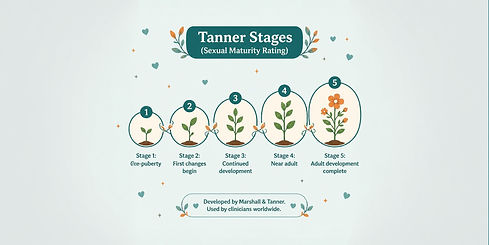
The Tanner stages are an objective system for tracking how far puberty has progressed, based on visible physical development. Also called the Sexual Maturity Rating, the system was developed by researchers Marshall and Tanner and is, as StatPearls (NCBI) describes, an objective classification that providers use to document and track the sequence of pubertal development. It runs from stage 1 (before puberty) to stage 5 (adult development). As Cleveland Clinic emphasizes, there is a wide range of normal in the timing of these stages, and every child develops at their own rate, so the scale is a general guide rather than a strict rule.
THE 5 TANNER STAGES & HOW THEY RELATE TO PUBERTY-PAUSING MEDICATIONS
Here is each stage in plain terms, alongside what it means for the timing of puberty-pausing medication.
Sources: StatPearls (NCBI); Cleveland Clinic; Endocrine Society dosing standards; Journal of Adolescent Health (2023).
WHY TANNER STAGE 2 IS THE KEY THRESHOLD
Stage 2 matters because it marks the first physical changes of puberty, which is exactly what puberty-pausing medication is meant to pause. The Endocrine Society's dosing standards state that pubertal suppression with GnRH agonists can start at the earliest stages of puberty, Tanner stage 2.
A 2023 study in the Journal of Adolescent Health similarly notes that the medication is typically given after a young person has reached Tanner stage 2, following careful clinical assessment that considers the young person's goals and the family's readiness.
Before stage 2, there is nothing to pause, which is why the medication is not used earlier. For the age question specifically, see at what age you can start puberty blockers.
HOW CLINICIANS DETERMINE THE TANNER STAGE
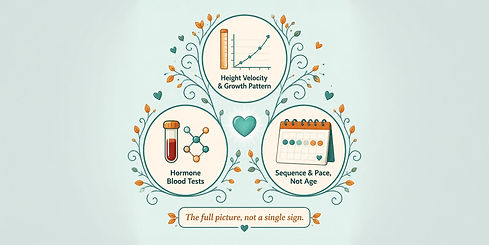
Clinicians assess the stage through physical development, often supported by other measures, and they look at the overall pattern rather than any single sign. As StatPearls notes, breast and genital development, along with markers like height velocity, are weighed together to gauge pubertal progress. Blood tests measuring puberty-related hormones can supplement the clinical picture. Because young people progress at different rates, clinicians focus on the sequence and pace of development, not a child's age. This is part of the careful evaluation described in how trans teens are assessed for care.
TANNER STAGES & LATER STEPS
While stage 2 relates to puberty-pausing medication, the later stages relate to when gender-affirming hormones may be considered.
The Journal of Adolescent Health describes stages 2 and 3 as earlier phases of puberty and stages 4 and 5 as the point when most pubertal changes have taken place.
Gender-affirming hormones are generally a step for older adolescents, in later puberty, and are a separate decision made after further assessment.
For the full sequence, see the steps of medical transition, and for how the pause itself works, see what puberty-pausing medication is.
STAGE, NOT AGE
The whole point of using Tanner stages is that development, not a birthday, is what matters, and normal timing varies widely. One young person may reach stage 2 at a notably different age from a peer, and both are developing typically. This is why guidelines and clinicians describe the timing of puberty-pausing medication in terms of the Tanner stage rather than a set age. For the typical age ranges these stages tend to fall in, and the caveats around them, see what age you can start puberty blockers.