

WHAT IS GENDER DYSPHORIA?
Gender dysphoria is the distress a person can feel when their gender identity does not match the sex they were assigned at birth. Two things are essential to understand from the start. It names the distress, not a person's identity, and being transgender is not itself a mental illness. Not everyone who is transgender experiences gender dysphoria; some feel at ease with their bodies and identities. It is a recognized medical diagnosis, and the distress it describes often eases with support and, for some people, care. Understanding gender dysphoria as distress, rather than as a label for being transgender, is the key to understanding the term correctly.
Because the phrase sounds clinical and can be confusing, it helps to be precise about what it does and does not mean, why it exists as a diagnosis, what it can feel like, and what helps. This page lays that out in plain language, with sources.
CONTENT NOTE
This is general information, not personal medical advice. Whether this medication is appropriate for a particular young person is a decision for that young person, their family, and their qualified healthcare providers, and in nearly all cases minors cannot receive it without parental consent. If you are in immediate danger, call 911; for support any time, call or text 988.
KEY TAKEAWAYS
-
It's distress, not identity. Gender dysphoria is the distress from a mismatch between gender identity and sex assigned at birth, not the identity itself.
-
Being transgender is not a mental illness. The American Psychiatric Association states plainly that "transgender" is not a psychiatric diagnosis.
-
Not everyone experiences it. Some transgender people have gender dysphoria; others feel at ease and do not.
-
The diagnosis helps people get care. The diagnosis was designed to help people access the support and treatment they need.
-
It often eases. Support, an accepting environment, and, for some, care are associated with less distress.
WHAT GENDER DYSPHORIA IS
Gender dysphoria is the psychological distress that can result when a person's gender identity differs from the sex they were assigned at birth.
As Mayo Clinic describes it, gender dysphoria is a feeling of distress that can happen when a person's gender identity differs from their sex assigned at birth.
The American Psychiatric Association similarly defines it as the psychological distress that results from an incongruence between one's sex assigned at birth and one's gender identity. It is the distress that is being named, not the person's gender.
WHAT GENDER DYSPHORIA ISN'T
Several common impressions of the term are inaccurate, and clearing them up is central to understanding it. Being transgender is not a mental illness; gender dysphoria is not the same as being transgender, and not every transgender person experiences it.
The clearest way to see the distinction: according to the American Psychiatric Association, the term "transgender" is not a psychiatric diagnosis. Some people who are transgender experience gender dysphoria; others do not.
As Mayo Clinic puts it, some transgender and gender-diverse people have gender dysphoria at some point, while others feel at ease with their bodies and identities and do not. A 2024 commentary in Pediatrics makes the same point and adds that gender diversity is a normal part of child development.
WHY IT'S A DIAGNOSIS, AND WHAT THAT MEANS
Gender dysphoria is a diagnosis in the American Psychiatric Association's DSM-5-TR, and the diagnosis was designed to name the distress and open the door to care, not to label anyone's identity as disordered. As Mayo Clinic explains, the diagnosis was created to help people with gender dysphoria get access to the healthcare and treatment that they need.
The current diagnosis also replaced an older one, "gender identity disorder," a change the American Psychiatric Association made specifically to focus on the distress rather than on a person's identity, and to reduce stigma. In other words, the diagnosis exists to support people, and its very design reflects that gender diversity itself is not a disorder.
WHAT GENDER DYSPHORIA CAN FEEL LIKE
Gender dysphoria can show up as an ongoing, significant discomfort related to one's body or to being seen as a gender that does not fit, though it looks different for different people.
According to the American Psychiatric Association's description of the DSM-5-TR criteria, it can include a marked mismatch between a person's experienced gender and their physical characteristics, a strong desire to be treated as their gender, and distress that lasts at least six months and meaningfully affects daily life.
It is more than not conforming to gender stereotypes; the defining feature is genuine, lasting distress. For a young person, this might look like distress about the physical changes of puberty, or discomfort at being called a name or pronoun that does not fit.
If you are noticing this in your own child, our guidance on how to support a transgender teen may help.
GENDER DYSPHORIA & PUBERTY
Gender dysphoria often arises or intensifies with puberty, when the body begins to develop in ways that may feel at odds with a young person's sense of themselves. This is one reason puberty is a significant time in supportive care, and why some of the options discussed for adolescents are tied to the start of puberty.
For how that works, see what puberty blockers are and how gender-affirming care works. None of this means every young person will need medical care; most support is social and psychological.
GENDER DYSPHORIA & MENTAL HEALTH
Gender dysphoria is specific distress about a gender mismatch, and it is different from the higher rates of depression and anxiety seen among transgender young people, which research attributes largely to stigma and mistreatment rather than to being transgender. It is worth keeping these separate.
Gender dysphoria is the internal distress of incongruence; the elevated rates of conditions like depression and anxiety among trans youth are driven by external factors such as rejection and discrimination, not by gender identity itself. We cover that fuller picture, with sources, on our pages on youth mental health statistics and depression and anxiety in trans youth.
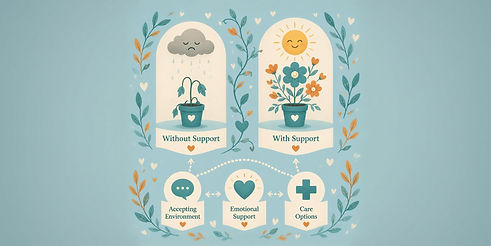
Support and an accepting environment are associated with less distress, and for some people, care of various kinds can reduce dysphoria further. Because gender dysphoria is distress rooted in a mismatch, the things that help are those that ease that mismatch and support the person: being seen and treated as their gender, a supportive family and community, mental-health support, and, for some, social or medical care decided with qualified providers.
Much of what helps is not medical at all; see supporting a trans child without medical steps. What is right for any individual is a decision for that person, their family, and their providers.