
Gender Identity vs. Sex Assigned at Birth: What Is the Difference?
KEY TAKEAWAYS:
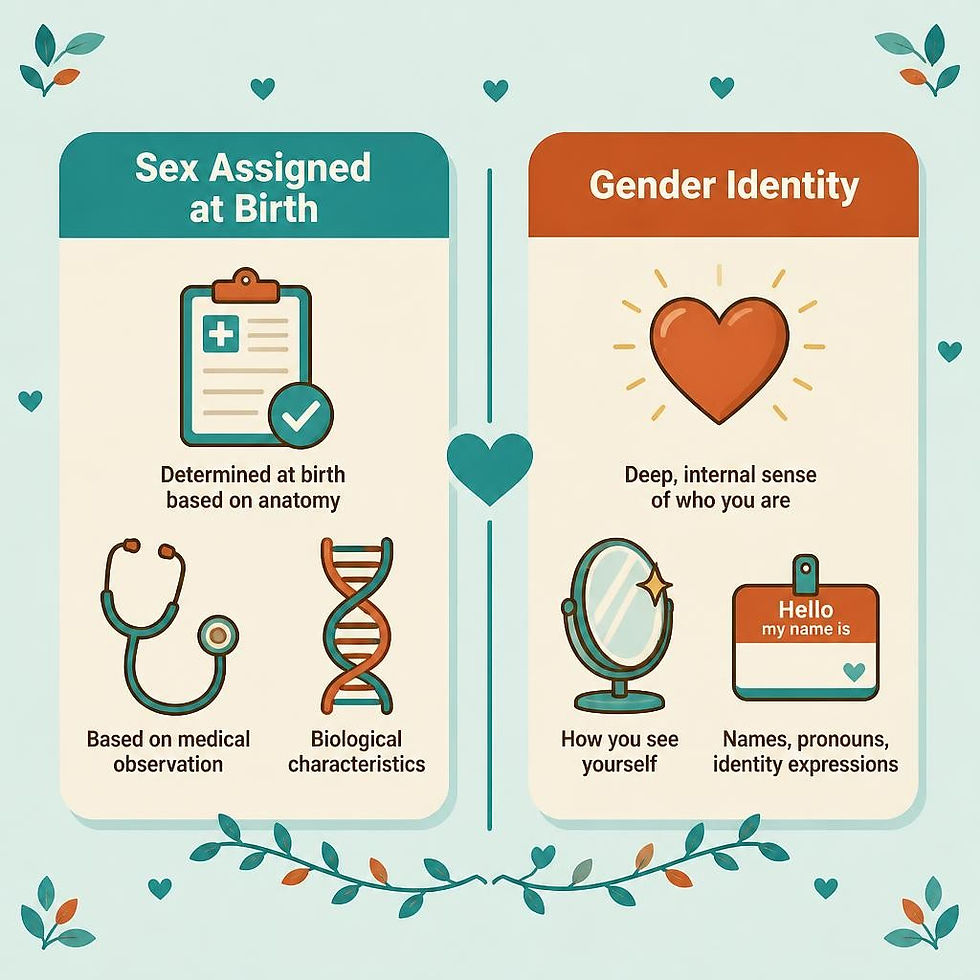
Sex assigned at birth is the male or female label a clinician records shortly after delivery, almost always based on the visible appearance of external genitals. Gender identity is a person's internal, deeply felt sense of being male, female, both, or neither.
The two usually align, a state commonly described as cisgender. When they do not align, that difference is called transgender or nonbinary, and it is neither a disorder nor a choice.
Sex assigned at birth is a snapshot taken from external anatomy alone. It does not capture chromosomal, gonadal, and hormonal sex together, which is one reason differences of sex development occur in a meaningful share of births.
Research following transgender children over time finds their gender identity functions the same way cisgender children's identity does, on the same psychological measures.
The American Academy of Pediatrics and the Centers for Disease Control and Prevention both treat gender identity vs. sex assigned at birth as well-established clinical vocabulary, not a matter of opinion.
The short answer
Sex assigned at birth is the label, male or female, written on a birth certificate shortly after delivery, based almost entirely on what a newborn's external genitals look like. Gender identity is something different: a person's own internal sense of their gender, which can match that label or not. At TransHealthHub, we find that the fastest way to defuse confusion in this conversation is to hold gender identity vs. sex assigned at birth as two separate, non-competing facts about a person, one observed by a clinician at birth and one known only by the individual.
How sex assigned at birth is determined, and why it isn't the whole story. A clinician typically assigns sex at birth by examining external genital anatomy, then records male or female on the birth certificate within days. That single observation is a starting point, not a complete biological picture, since a standard newborn exam does not check chromosomal, gonadal, or hormonal factors.
Because those factors do not always point in the same direction, a meaningful share of births do not fit a clean binary at the biological level. A 2025 statement from the North American Society for Pediatric and Adolescent Gynecology describes biological sex as genetic, gonadal, and anatomic components that can vary independently, and puts the rate of differences of sex development, conditions where those components do not align with one another, at about 1 in 4,500 people.
The Cleveland Clinic cites separate estimates ranging up to roughly 1 in 2,700 depending on which conditions are counted. The two figures differ because they draw the diagnostic line in different places, and both point to the same underlying fact: sex assigned at birth is a useful shorthand, not a complete biological census.
What gender identity means
Gender identity is a person's own internal sense of being a man, a woman, both, or neither, and it belongs to that person alone. The CDC describes it as something every person has, transgender or not, and distinguishes it clearly from gender expression, how someone outwardly presents, and from sexual orientation, who someone is attracted to. The American Academy of Pediatrics makes a related point in its 2018 policy statement, noting that gender identity and sexual orientation are distinct but interrelated constructs, so a transgender person's orientation is described the same way anyone else's would be: straight, gay, bisexual, or another orientation entirely.
Gender identity is something a person comes to know and communicate over time, sometimes in early childhood and sometimes later, not something a clinician can observe or measure at birth. A study published in Psychological Science compared transgender children ages 5 to 12 with two groups of cisgender children on implicit and explicit measures of gender identity, and found the transgender children’s results were indistinguishable from cisgender children who shared their identified gender. The researchers described this as evidence that these children’s sense of self functions the same way as their peers’, rather than reflecting confusion.
Gender identity vs. sex assigned at birth, side by side
Sex assigned at birth | Gender identity | |
Basis | External genital anatomy at birth | A person's internal sense of self |
Who determines it | A clinician, at or shortly after birth | The individual, over their own life |
When it is recorded | Within days of birth | Not observable at birth; communicated later |
Can it be incomplete | Yes; does not capture chromosomal or hormonal sex | No; it is the person's own report |
Example categories | Male, female, or intersex traits | Man, woman, nonbinary, and others |
When they align, and when they don't
For most people, gender identity and sex assigned at birth point in the same direction, an alignment described as cisgender. When they diverge, a person may identify as transgender, nonbinary, or another term that fits their own experience. The distinction alone says nothing about a person's mental health. Some transgender people experience clinically significant distress tied to that mismatch, which clinicians diagnose as gender dysphoria, a separate concept we cover in depth on our page about gender dysphoria. Many transgender people do not experience that distress at all.
The alignment between gender identity and sex assigned at birth is also not fixed by definition for everyone. Most people's sense of their own gender is stable over time, and the research above finds this holds for transgender children too, but for a minority of people, gender identity can continue to develop or shift, particularly during adolescence. That variability is a normal part of identity development, not evidence that the concept itself is unreliable.
Why this distinction matters
Understanding gender identity vs. sex assigned at birth is what lets families, schools, and clinicians talk about a young person’s needs without talking past each other, rather than an abstract academic distinction. A parent who understands that gender identity is not a phase, a preference, or a symptom is better equipped to respond to it directly rather than to argue with a label on a birth certificate.
It also matters for care. Families exploring what support looks like in practice can start with our overview of supportive care, most of which is social and psychological rather than medical, especially for younger children. For older adolescents who continue to experience a difference between their gender identity and their sex assigned at birth into puberty, later medical options such as hormone therapy may become part of the conversation, always after careful, individualized assessment with qualified clinicians.
Frequently asked questions
Is gender identity a choice? No. Major medical and psychological organizations describe gender identity as an internal sense of self, not a preference a person selects or can be talked out of.
Can sex assigned at birth be wrong? Sex assigned at birth reflects what a clinician observed at the time, based on external anatomy. It can be incomplete, particularly for people with differences of sex development, and it does not determine a person's gender identity.
Are gender identity and gender expression the same thing? No. Gender identity is internal. Gender expression is how someone presents that identity outwardly, through clothing, name, or behavior, and the two do not always look the way an observer expects.
Further Reading and Resources
American Academy of Pediatrics, 2018 policy statement on transgender and gender-diverse youth: full policy statement
CDC, terminology for gender and sexual identity: reference page
NASPAG, 2025 statement on biological sex development and differences of sex development: full statement
Cleveland Clinic, what it means to be intersex: patient guide
Olson, Key, and Eaton, “Gender Cognition in Transgender Children,” Psychological Science (2015): journal abstract
This page addresses a health topic and reflects the evidence as of August 2026. It is not medical advice. Decisions about care belong to the young person, their family, and their clinicians.
Comments